
A yard that stays wet for days after a normal rain is not just frustrating. It keeps grass thin, stains concrete, creates muddy paths, and can start pushing water toward your foundation. That is why homeowners often start searching for yard drainage project examples – they want to see what actually works before they spend money on a fix.
The truth is, drainage problems do not all come from the same source. One property may need a simple catch basin and pipe run. Another may need grading, a swale, and a retaining feature working together. The best projects solve the water issue at its source instead of just moving puddles from one corner of the yard to another.
What good drainage projects have in common
A successful drainage project starts with understanding where the water comes from, where it collects, and where it can safely go. In East Texas, that often means dealing with heavy rain, clay soils, and flat or gently sloped lots that do not drain quickly on their own.
The most effective projects usually do three things well. They collect water where it builds up, move it through the yard without damaging the landscape, and discharge it in a place that will not create a new problem. That sounds simple, but the right design depends on the layout of the home, the elevation of the lot, existing hardscaping, and how the space is used every day.
Yard drainage project examples for common homeowner problems
1. French drain along a soggy side yard
This is one of the most common fixes for homes where the side yard stays wet long after rain has passed. The issue usually shows up as soft ground, patchy grass, and water sitting between the house and fence line.
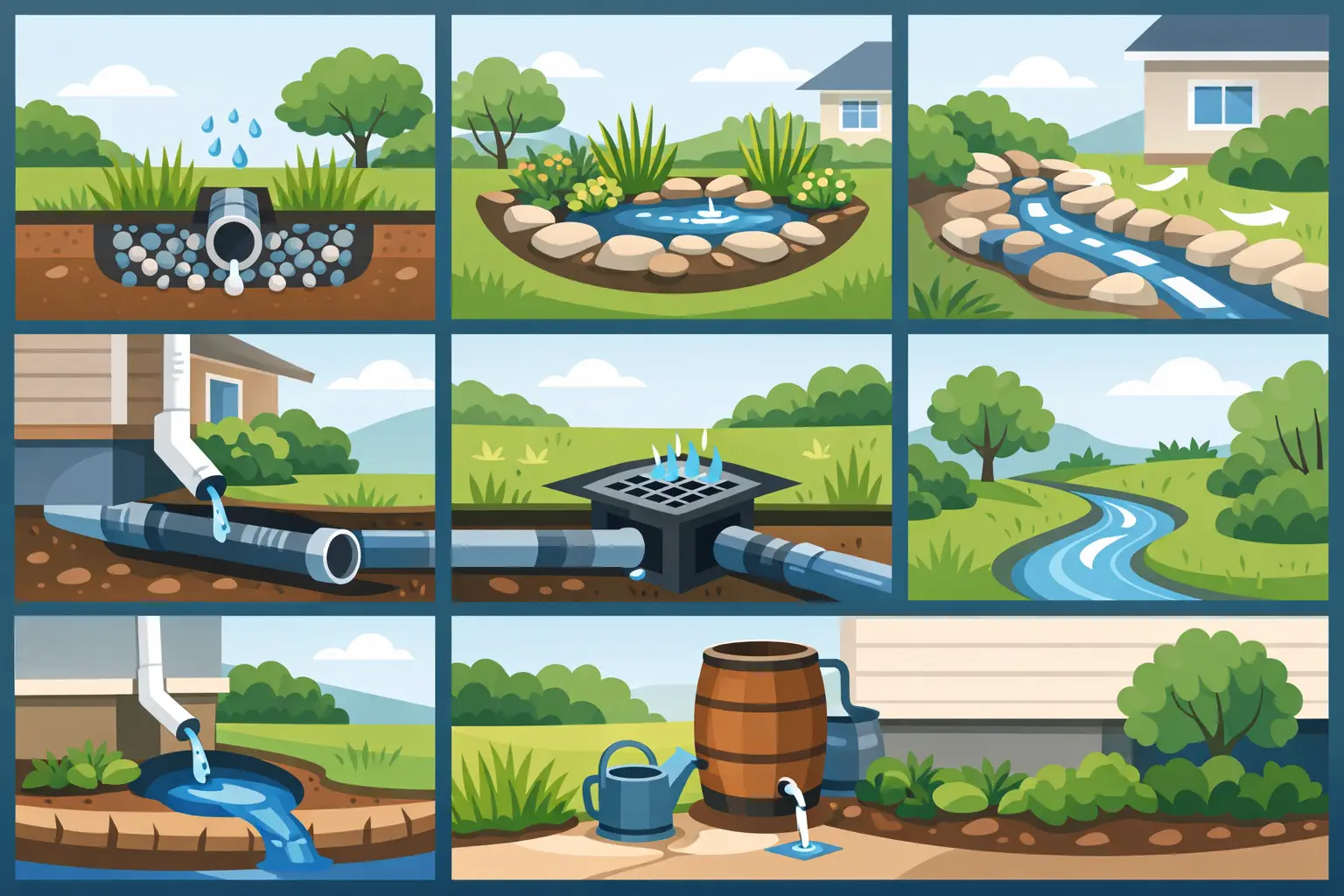
In this type of project, a trench is dug in the low area, then lined and filled around a perforated pipe that collects groundwater and redirects it away from the problem zone. The pipe typically carries water toward a pop-up emitter or another approved discharge point farther downhill.
A French drain works well when the ground is holding water below the surface, not just on top. It is less effective if the yard is flat and there is nowhere for the water to go. In those cases, the drain may need to be paired with grading or another collection method.
2. Catch basin and solid drain pipe at a patio edge
When water rushes off a roofline or across a hard surface, it often collects near patios, walkways, or back doors. A catch basin project is designed to intercept that surface water quickly before it floods a usable area.
A basin is installed at the low point where water naturally gathers. From there, solid pipe carries the water away underground. This is a practical choice when runoff is concentrated in one visible area, especially near concrete or paver surfaces.
The trade-off is that catch basins need proper placement and routine cleaning. If leaves, mulch, or debris build up over time, water can back up again. Still, for targeted surface drainage, this is often one of the cleanest and most efficient solutions.
3. Regrading a backyard that slopes toward the house
Some drainage issues are not really pipe problems. They are grading problems. If the yard pitches back toward the home, water will keep moving toward the slab or crawl space no matter how many small fixes are attempted.
In this kind of project, the soil grade is reshaped so water flows away from the house instead of toward it. That may include bringing in fill dirt, smoothing low spots, and resetting the slope across lawn areas or planting beds.
Regrading is not always dramatic, but it can make a major difference. It is especially important around foundations. The challenge is that regrading can affect fences, flower beds, patios, and existing drainage patterns, so it needs to be planned carefully as part of the whole yard rather than one isolated area.
4. Swale installation for wide backyard runoff
A swale is a shallow, sloped channel that guides surface water across a property in a controlled way. It is useful when water spreads across a broad area instead of collecting at one small low point.
This project is common on larger residential lots where runoff moves from neighboring yards or from the rear of the property toward the house. Instead of forcing all the water into underground piping, a swale works with the natural contour of the land and gives water a path to follow.
Swales can be blended into the landscape so they do not look harsh or out of place. The main consideration is space. If a yard is small or tightly developed, there may not be enough room to shape a swale without affecting how the yard functions.
5. Downspout extension tied into underground drainage
Sometimes the biggest drainage problem is right at the roofline. If downspouts empty next to the house, that water can saturate the soil near the foundation and create constant wet areas in flower beds or along the perimeter.
A more complete project routes those downspouts into underground pipe and sends the water farther out into the yard or to a proper exit point. This keeps roof runoff from dumping in the same place every time it rains.
This is one of the most practical drainage upgrades because it targets a very specific source. It is also a project that works best when the pipe route is planned around existing landscaping, sidewalks, and fence gates. A quick extension above ground may help short term, but buried drainage usually delivers a cleaner and more reliable result.
6. Retaining wall with integrated drainage
On sloped lots, water pressure and soil movement often go together. If a retaining wall is being built or replaced, drainage should be part of the design from the start, not added later as an afterthought.
A good retaining wall drainage project may include gravel backfill, drainage pipe behind the wall, and outlets that relieve hydrostatic pressure. Without those elements, water can build up behind the wall and shorten its life.
This is a good example of why one-service fixes do not always solve the bigger issue. A homeowner may think they only need erosion control, when the real answer is a retaining structure and a drainage plan working together. For properties with both slope and runoff problems, that combination often protects the yard better over time.
7. Full backyard drainage system for repeated flooding
Some properties need more than one tool. If a backyard floods after every heavy rain, there may be multiple causes at once – poor grading, roof runoff, compacted soil, and low spots with nowhere to drain.
A full drainage project might combine regrading, French drains, catch basins, downspout tie-ins, and discharge planning into one coordinated system. This type of project is more involved, but it usually gives the best long-term result when the problem has become a pattern rather than an occasional nuisance.
The benefit of a full system is that each part supports the others. The downside is cost and planning. Still, piecing together small repairs over several years can end up costing more if the underlying drainage layout never gets corrected.
How to tell which yard drainage project makes sense
The right solution depends on how water behaves on your property, not just where you see the puddle. Standing water in the lawn may actually start with roof runoff. Mud near the patio may be caused by a slope issue on the far side of the yard. What looks like a simple low spot can sometimes be a sign that the whole drainage path is failing.
That is why visual symptoms only tell part of the story. A good evaluation looks at elevation changes, soil conditions, the path of runoff, existing drains, and how close water gets to the home. In Tyler and across East Texas, clay-heavy soils can make drainage issues more stubborn because water drains slowly and the ground compacts easily.
When drainage should be combined with other yard improvements
Some of the best results come when drainage is handled as part of a broader outdoor project. If a homeowner is already replacing a fence, adding a retaining wall, reworking landscaping, or updating a patio, that can be the ideal time to fix water movement too.
Doing both together helps avoid redoing finished work later. It also allows the yard to function and look better at the same time. A drainage system should protect the property, but it should also fit naturally into the landscape instead of making the yard feel patched together.
For homeowners who want practical answers instead of guesswork, the value is in choosing a solution that matches the property. Some drainage problems need a focused fix. Others need a more complete plan. The right project is the one that keeps water moving where it should, protects the areas you use most, and gives you a yard that feels dependable again after the next heavy rain.