
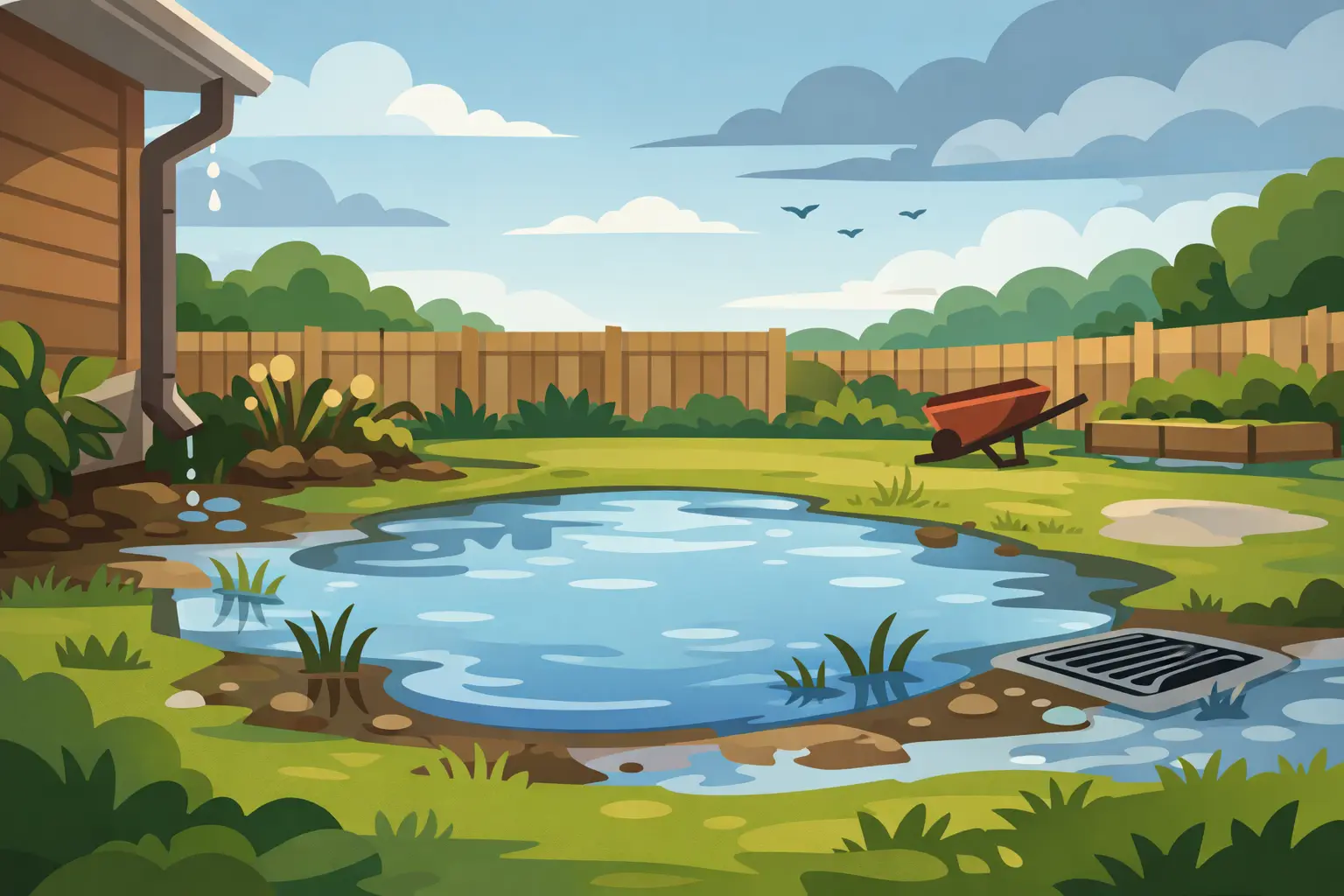
You usually notice yard drainage problems after a hard East Texas rain, when one section of the lawn stays soggy long after everything else has dried out. If you are asking what causes standing water yard issues, the short answer is that water is collecting faster than your property can absorb it, move it, or drain it away. The real answer is more specific, and finding the true cause matters because the right fix for one yard can be the wrong one for another.
Standing water is not just an eyesore. It can kill grass, attract mosquitoes, soften the ground around fences, wash mulch out of beds, and put extra pressure on your home’s foundation. In some yards, it also makes patios, play areas, and walkways harder to use. That is why drainage problems are worth dealing with early, before a soft spot turns into a bigger and more expensive repair.
What causes standing water in a yard most often?
In most residential yards, standing water comes from a grading problem, compacted soil, poor outlet drainage, or a low spot that acts like a bowl. Sometimes it is one issue. More often, it is a combination.
A yard may look flat, but a slight slope in the wrong direction can send runoff straight toward the house or into one corner of the property. If the water has nowhere to go once it gets there, it lingers. That is especially common in neighborhoods where multiple lots were built close together and drainage patterns changed during construction.
Soil type plays a major role too. Much of East Texas has clay-heavy soil, and clay drains slowly compared with looser, sandier soil. When clay gets saturated, water can sit on the surface instead of soaking in. Even a well-maintained yard can struggle if the soil below it is dense and holds moisture.
There is also the issue of compaction. Foot traffic, mowing patterns, construction activity, and even repeated rainfall can compress soil over time. Once the ground is compacted, water cannot move through it easily. That means even moderate rain can create puddles where the lawn used to drain well.
The most common yard drainage problems behind standing water
Poor grading around the home
Grading refers to the shape and slope of your yard. Ideally, the ground should guide water away from your home and toward a safe drainage area. If the grade slopes back toward the house, water tends to pool near the foundation, along flower beds, or beside walkways.
This is one of the most serious drainage issues because it affects more than the lawn. Water that stays too close to the house can lead to foundation movement, moisture intrusion, and erosion. Sometimes homeowners notice the symptom first, like muddy spots or dead grass, without realizing the larger risk underneath.
Low spots that collect runoff
Some yards have natural depressions. Others develop low areas over time as soil settles. These spots work like basins, catching runoff from the roof, neighboring lots, and higher sections of the yard.
A low spot may seem minor during dry weather, but after repeated storms, it can become the place where all excess water ends up. If it stays wet for days, the problem is not only the depression itself. It is also the lack of an effective path for water to leave.
Compacted or heavy clay soil
This is a major reason homeowners ask what causes standing water in a yard when the surface looks mostly level. The issue may be below grade rather than above it.
Compacted soil limits infiltration. Heavy clay slows drainage even further. Together, they create a situation where water lands on the yard and simply sits there. In these cases, adding more topsoil alone may not solve much unless the underlying drainage conditions improve.
Downspouts that dump too much water in one place
Your roof moves a surprising amount of water during a storm. If gutters and downspouts release that water right beside the house, it can overwhelm a small section of yard very quickly.
This often creates persistent wet areas near corners of the home or along the side yard. The lawn may stay soggy, mulch may wash away, and water may begin creeping toward the slab. Extending or redirecting downspouts can help, but it depends on whether the water has a proper outlet after it leaves the downspout.
Blocked or failing drainage systems
Some properties already have drains, catch basins, or underground pipes in place, but those systems are not maintenance-free. They can clog with mud, leaves, roots, or debris. If that happens, water backs up and starts pooling where it should have drained.
This can be tricky because homeowners assume that since a drain exists, drainage should be handled. In reality, an undersized, damaged, or blocked system may do very little during a heavy rain.
Runoff from neighboring properties
Not every drainage problem starts on your lot. If nearby homes sit higher than yours, stormwater may naturally flow downhill into your yard. That does not always mean anything was built incorrectly, but it does mean your property may need added drainage support to manage the extra volume.
This is one reason drainage work should be customized. A solution that works on an isolated lot may not be enough for a yard receiving runoff from several directions.
Signs the problem is bigger than a few puddles
A few temporary puddles after a major storm are not unusual. What matters is how long the water stays and what else is happening around it.
If water remains in place for more than a day or two, that points to poor drainage rather than a one-time weather event. Yellowing grass, mossy patches, eroded mulch beds, muddy fence lines, and soft spots in the lawn are all warning signs. You may also notice water stains near the foundation, standing water around downspouts, or bare areas where grass cannot survive.
When drainage problems keep returning, the yard is telling you the issue is structural, not cosmetic. Reseeding alone will not fix that. Neither will adding a thin layer of soil if the slope and water flow remain the same.
Why the right fix depends on the cause
This is where many homeowners lose time and money. They treat the visible puddle instead of the reason it formed.
For example, if the main issue is compaction, aeration and soil improvement may help. If the yard is trapping runoff because of poor grading, the better answer may be regrading the area so water can move away naturally. If roof water is the culprit, downspout extensions or buried drain lines may be needed. If a low section of lawn keeps collecting water, a French drain, catch basin, or swale could make more sense.
There is rarely a one-size-fits-all fix. Gravel on top of a wet area may make it look cleaner for a while, but it does not remove the water source. The same goes for simply filling a puddle without correcting the surrounding slope. Water usually comes back, and sometimes it spreads the problem somewhere else.
What causes standing water yard problems in East Texas?
In Tyler and surrounding East Texas communities, drainage problems often come down to a mix of heavy rainfall, clay-rich soil, and yard grading that does not move water efficiently. New construction can leave compacted ground behind. Older properties may have settled over time. Mature landscaping, added patios, fences, and other improvements can also change how water moves across the lot.
That is why drainage work should be looked at as part of the whole outdoor space. A yard is not just grass. Beds, hardscaping, fences, retaining walls, and roof runoff all affect where water goes. When those elements work together, the property is easier to maintain and more enjoyable to use.
When to call a professional
If standing water keeps showing up in the same place, if the area is close to your foundation, or if previous quick fixes have not worked, it is time for a closer look. A professional can evaluate slope, runoff patterns, soil conditions, and drainage outlets to identify the real problem.
That matters because some drainage issues are simple, while others involve multiple layers. A yard may need regrading in one section and drainage collection in another. It may need water redirected before any landscaping improvements make sense. At Cullz Outdoor LLC, that bigger-picture approach is often what helps homeowners avoid repeating the same drainage problem year after year.
The good news is that standing water is usually fixable once the cause is clear. A dry, usable yard starts with understanding how water moves across your property and giving it a better path to follow.