
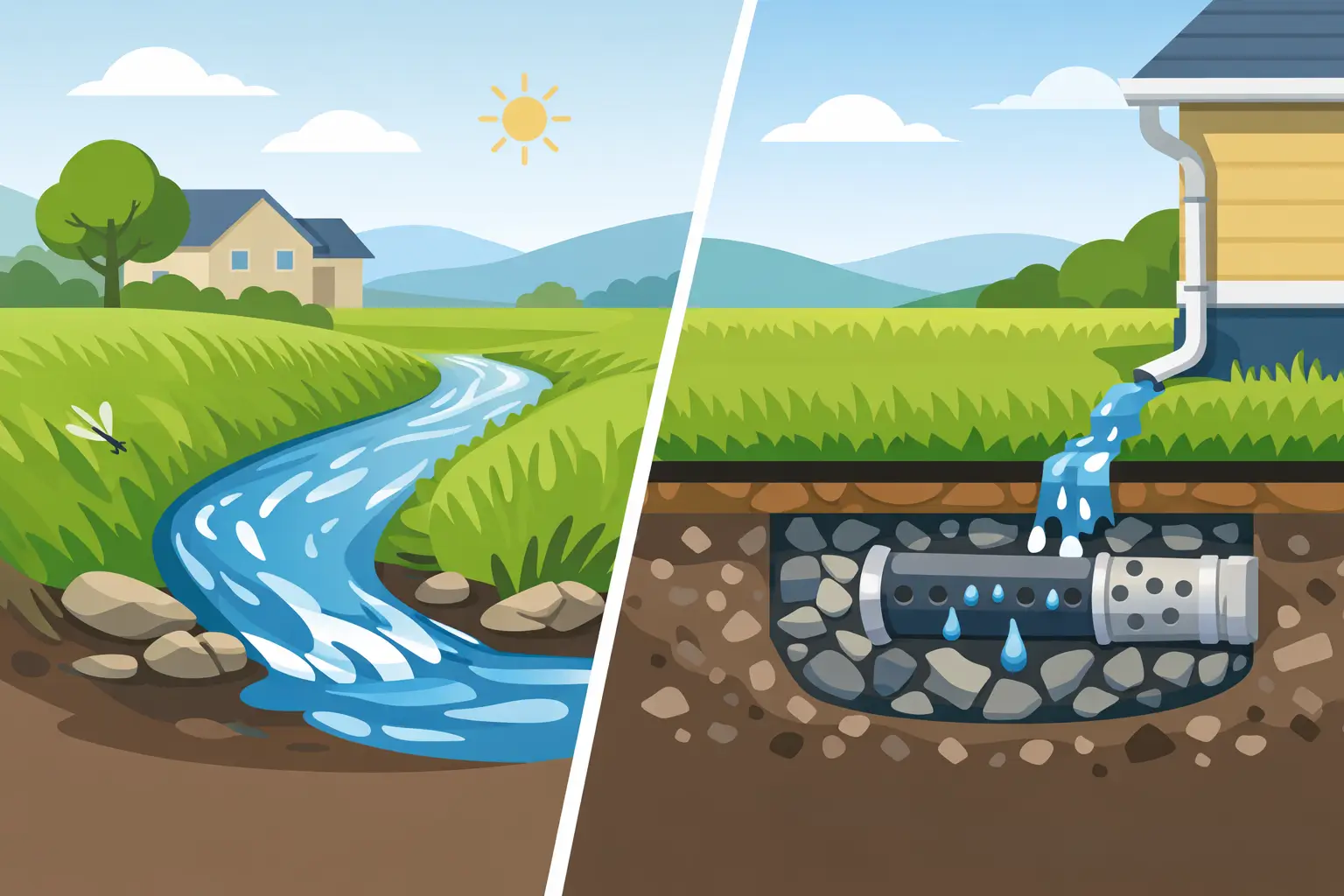
A yard can look perfectly level on a dry afternoon, then reveal its real drainage problem after a hard East Texas rain. Water gathers beside the foundation, turf stays soft for days, mulch washes out, or a backyard becomes unusable. When comparing a drainage swale vs french drain, the right choice comes down to where the water starts, how much water moves through the yard, and whether the surface can be reshaped to carry it away.
Both systems can protect a lawn and improve how your outdoor space functions. They do very different jobs, though. A swale manages water across the surface of the landscape, while a French drain collects water below ground and redirects it through a perforated pipe. Choosing based on appearance alone can leave the real problem untouched.
Drainage Swale vs French Drain: The Main Difference
A drainage swale is a broad, shallow channel shaped into the yard. It follows a gentle slope and guides runoff toward a safe discharge area, such as a lower part of the property, a drainage easement, or another approved outlet. A well-built swale does not have to look like a ditch. It can be incorporated into the lawn or finished with river rock, plants, and defined edges where appropriate.
A French drain is a trench system. It typically includes perforated pipe surrounded by gravel and wrapped in filter fabric, then covered with gravel, soil, or sod. Water enters through the gravel, reaches the pipe, and travels to an outlet. French drains are especially useful when water is collecting below the surface or when runoff cannot be handled by reshaping the grade alone.
The simplest way to think about it is this: a swale gives rainwater an easier route over the yard, while a French drain gives trapped water a route through the ground.
When a Drainage Swale Is the Better Choice
Swales work best when the primary issue is surface runoff. If rain flows down a sloped lawn toward the house, across a driveway, or into a low area, a properly graded swale can intercept that water before it reaches the problem spot.
They are often a practical solution for larger open yards because they can move a high volume of water without requiring a long underground trench. In Tyler and surrounding East Texas communities, intense rainstorms can send a lot of water across a property in a short time. A swale is built to work with that natural movement rather than trying to collect every drop underground.
A swale may be a good fit when:
- Water runs visibly across the lawn during storms.
- The yard has enough space for a gradual, shallow channel.
- The property has a safe downhill outlet for water.
- You want a drainage solution that can blend into a landscaped yard.
The trade-off is that swales need room and correct grading. They are not ideal for every narrow side yard or tightly fenced backyard. They also need routine care. Grass, leaves, mulch, and soil buildup can slow the flow if the channel is not kept clear.
When a French Drain Makes More Sense
A French drain is usually the stronger option when water is sitting in one location instead of flowing naturally away. Common examples include a soggy strip between homes, a low spot at the base of a retaining wall, wet soil around a patio, or water that lingers near the foundation after rainfall.
Because the system is installed underground, it can solve drainage concerns without changing the visible layout of the yard as much as a swale would. This is valuable in smaller properties where every part of the lawn has a purpose for kids, pets, entertaining, or landscaping.
A French drain can also be paired with downspout extensions. Roof runoff should not be dumped directly beside the home. Routing that water into a properly designed drainage system can reduce erosion, protect planting beds, and help keep moisture away from the foundation.
Still, a French drain is not a cure-all. It needs an outlet. A pipe that ends in an already saturated low spot simply moves the water problem from one place to another. The trench must be graded correctly, the pipe must be sized for the job, and the discharge location must be appropriate for the property.
Appearance, Cost, and Long-Term Maintenance
For homeowners deciding between a drainage swale and a French drain, appearance is often part of the decision. A grass swale can be nearly invisible once established, although it may be noticeable after heavy rain as it carries water through the yard. A decorative rock swale creates a more intentional landscape feature and can help control erosion in areas with stronger runoff.
A French drain is generally more discreet after installation. Once sod or landscape material is restored, the system may not be visible at all. However, installation is more involved because it requires excavation, gravel, pipe, fabric, and careful outlet planning. Existing irrigation lines, landscape lighting, tree roots, fencing, and utilities must be considered before digging begins.
Costs vary based on the length of the system, depth of excavation, access to the yard, soil conditions, restoration work, and the complexity of the outlet. In many cases, a simple swale is less expensive than a French drain because it requires less material and labor. That does not automatically make it the better value. If subsurface water is the real issue, a lower-cost swale may not correct the problem.
Maintenance is different as well. Swales should be inspected after major storms and kept free of debris that blocks flow. French drains need fewer routine checks, but their outlets should remain clear. Over time, sediment can affect performance, especially if the system was installed without proper filter fabric or if surface soil has washed into the gravel.
East Texas Drainage Challenges Need a Site-Specific Plan
East Texas yards often deal with heavy rainfall, compacted clay soils, mature trees, and gradual grades that make water slow to leave. Clay can hold moisture for long periods, which is why a lawn may remain soft even after standing water disappears. A French drain may help relieve that saturated area, but the design must account for the soil and a reliable path for discharge.
Some homes have more than one drainage issue at the same time. For example, a backyard may need a swale to redirect hillside runoff, while a French drain handles water collecting beside a patio or retaining wall. Downspout extensions, regrading, catch basins, and erosion control may also be part of the same project.
This is why a quick visual diagnosis can be misleading. The low spot is not always the source of the problem. Water may be entering from a neighboring slope, roof runoff, a poorly graded fence line, or a hardscape surface that sheds water toward the lawn.
Questions to Ask Before Choosing a System
Before committing to either option, consider what happens during and after rainfall. Does water rush across the surface, or does it slowly pool and soak in? Is the affected area open enough to reshape? Where can the water legally and safely discharge without causing a new issue for your home or a neighbor?
It also helps to look at the entire outdoor plan. If you are adding a patio, fence, retaining wall, new planting beds, or fresh sod, drainage should be addressed before the final finishes go in. Correcting water flow first protects the investment and prevents tearing up completed work later.
A professional assessment should also identify underground utilities and account for local drainage rules, easements, and property lines. Water should be directed away from the home, but it should never be redirected in a way that creates drainage trouble next door.
Build the Solution Around How Your Yard Actually Drains
The best drainage system is the one that manages water at its source and gives it a clear path away from the areas you use most. A visible runoff problem may call for a carefully graded swale. A saturated low spot or confined side yard may need a French drain. In some yards, the most dependable result comes from combining both.
If rain regularly keeps you off part of your property or threatens areas near the home, do not wait for the next downpour to make the decision for you. A site-specific drainage plan from Cullz Outdoor LLC can turn a wet, frustrating yard into an outdoor space that is ready to use again.
Leave a Reply